Minimally Invasive Procedure for Long-Term Relief from Chronic Sinusitis

What Is Balloon Sinus Dilation?
Balloon Sinus Dilation is a non-surgical sinus procedure performed under local anesthesia, often in the comfort of your ENT’s office (insurance-dependent).
Unlike traditional sinus surgery, this technique:
- Does not remove bone or tissue
- Causes minimal bleeding
- Requires little to no downtime
- Allows most patients to return to normal activities within 24 hours
How Does Balloon Sinuplasty Work?
During the procedure:
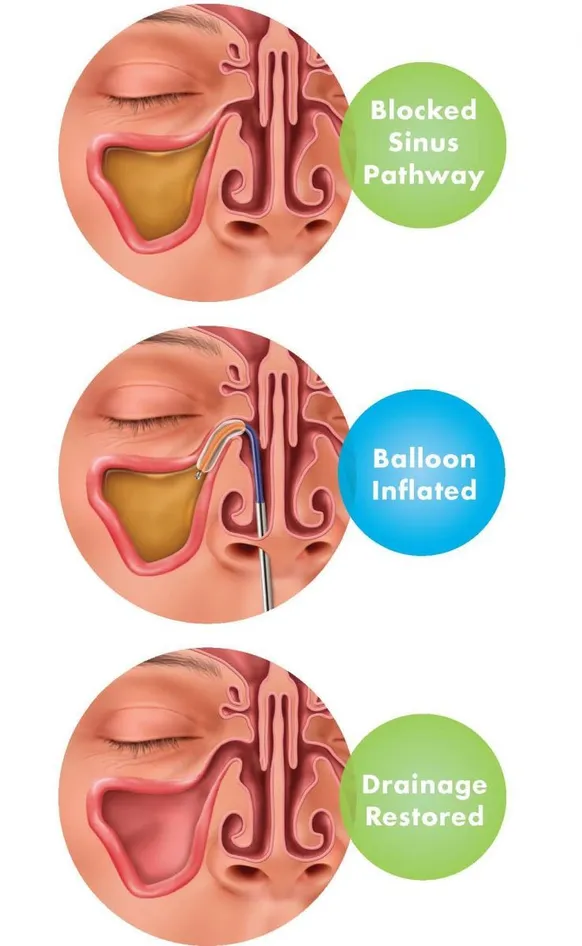
1. A small, flexible sinus catheter is gently inserted into the blocked sinus opening.
2. A tiny balloon is positioned within the narrowed passage.
3. The balloon is inflated for approximately 5–10 seconds.
4. The sinus opening is widened (remodeled) — sometimes up to six times its original diameter.
5. The balloon is deflated and removed.
This process restores natural sinus ventilation and drainage while preserving normal sinus anatomy.
Who Is a Candidate for Balloon Sinus Dilation?
Balloon Sinus Dilation may be appropriate for patients with:
- Chronic sinusitis lasting 12 weeks or longer
- Recurrent sinus infections
- Sinus symptoms not improved with medication
- Mild to moderate sinus blockage
If you are not a candidate for Balloon Sinus Dilation, traditional surgery may be recommended.
Balloon Sinus Dilation vs. Traditional Sinus Surgery (FESS)
Before 2005, Functional Endoscopic Sinus Surgery (FESS) was the primary surgical option when medications failed to relieve chronic sinusitis.
Key differences:
| Balloon Sinus Dilation | Functional Endoscopic Sinus Surgery (FESS) |
|---|---|
| Minimally invasive | Surgical procedure |
| No tissue or bone removal | Removes bone and tissue |
| Performed under local anesthesia | Often requires general anesthesia |
| Minimal downtime | Longer recovery |
| Less postoperative discomfort | More postoperative swelling |
Both procedures are effective, and your ENT specialist will determine which is best based on your anatomy and disease severity.
Clinical Evidence Supporting Balloon Sinus Dilation
The REMODEL study, published in the American Journal of Rhinology & Allergy, was the first randomized, multi-center clinical trial comparing in-office Balloon Sinus Dilation to traditional endoscopic sinus surgery.
The study demonstrated that Balloon Sinus Dilation:
- Is equally effective at improving long-term sinus symptoms
- Results in less postoperative pain
- Provides faster recovery time
- Can be safely performed in-office
Benefits of Balloon Sinus Dilation
- Safe and FDA-cleared technology
- Minimally invasive
- Little to no bleeding
- No cutting or tissue removal
- Quick recovery
- Long-term symptom relief
If you are experiencing chronic sinus pressure, congestion, or recurrent infections, a consultation with an ENT specialist can determine whether Balloon Sinus Dilation is right for you.
Recent Data Regarding Balloon Sinus Dilation:
Study: Chandra, Rakesh K., Kern, Robert C., Cutler, Jeffrey L., Welch, and Russell, Paul T. REMODEL larger cohort with long-term outcomes and meta-analysis of standalone balloon dilation studies. Laryngoscope. July 2015.
To take our Sinus Quiz, Click Here.
Balloon Sinus Dilation (BSD)